
Table of Contents
Elevator Inspection Services Hyderabad | Third-Party Safety Audits
A vertical transportation network requires rigorous, systematic verification to ensure public safety and operational reliability. Because passenger elevators operate under high tension and constant mechanical stress, they cannot rely solely on basic, routine maintenance checks. Component wear, safety-circuit degradation, and structural fatigue require detailed evaluations by certified professionals.
In Hyderabad’s expanding corporate districts, IT hubs, and multi-story residential communities, independent third-party assessments are essential. Utilizing qualified elevator inspection services in Hyderabad provides building managers, corporate real estate owners, and facility engineers with objective, data-driven verifications of system health, helping to ensure compliance with national safety frameworks.
This technical manual details the engineering methodologies, non-destructive testing (NDT) standards, physical workspace testing procedures, and reporting frameworks required to perform comprehensive safety audits on modern geared and gearless lift installations.
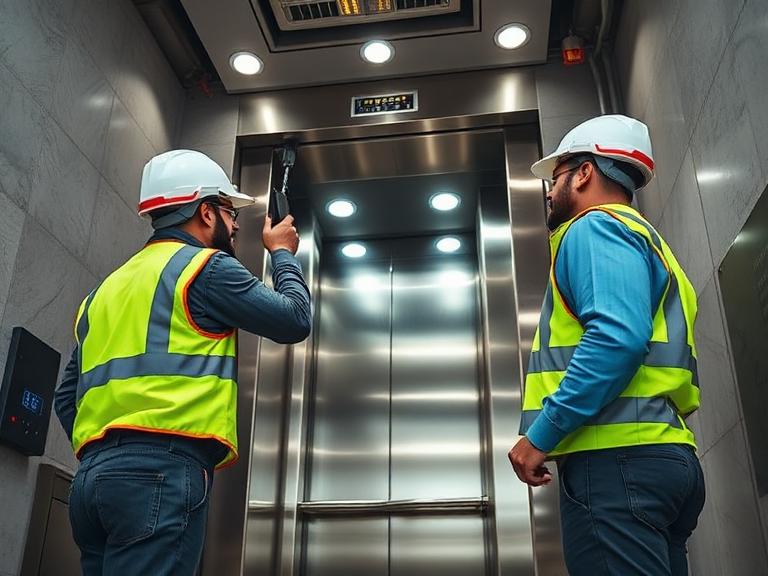
1. Statutory Frameworks & National Safety Compliance Standards
Elevator inspections are highly regulated procedures structured around strict national standards designed to eliminate mechanical and electrical risks.
A. The Indian Standard Code IS 14665 Architecture
The IS 14665 code serves as the primary engineering standard governing the design, installation, operation, and formal testing of vertical elevators across India.
- Scope of Audit: Inspectors evaluate the structural steel of the car sling, check the safety factors of the suspension wire ropes, measure the performance of the progressive safety gears, and calculate the stopping distances of the energy-absorbing buffers.
- Objective: Any component found to fall outside the tolerances defined by the IS 14665 code must be flagged for immediate repair to maintain system compliance.
B. Central Electricity Authority (CEA) Regulations
Elevator power distribution panels and control rooms must comply with the safety standards set by the Central Electricity Authority (CEA). Inspections include testing structural grounding pathways, measuring the insulation resistance of phase windings, verifying the operation of phase-reversal protection circuits, and testing the trip times of main circuit breakers to minimize fire and shock hazards.
2. Comprehensive Zone-Based Auditing Protocols
A thorough elevator inspection follows a systematic process, evaluating the installation across four distinct physical zones.
A. Zone 1: The Machine Room & Traction Electronics
The inspection begins at the primary drive station:
- Traction Sheave Inspection: Inspectors look for signs of wear in the sheave grooves, measuring the groove depth using precision profile gauges. Uneven groove wear can cause wire rope slippage and uneven load distribution.
- Electromechanical Brake Assembly Testing: The core mechanical brake pads are checked for wear, and the dual solenoid plunger stroke travel is measured to ensure the brakes release cleanly. Emergency backup power tests confirm that the Automatic Rescue Device (ARD) batteries can handle the load and bring the car to the nearest landing during a power failure.
B. Zone 2: The Hoistway Shaft Framework
Working from the top of the elevator cabin, inspectors move slowly down the shaft to check the structural components:
- Wire Rope Assessment: The primary hoisting cables undergo non-destructive electromagnetic testing (NDT) to locate broken internal steel strands, measure diameter reduction, and check for corrosion. Rope tension is checked using electronic gauges to ensure the load is distributed evenly across all cables.
- Guide Rail and Bracket Verification: The vertical alignment of the solid steel T-rails is verified using laser alignment tools to ensure the cabin travels smoothly without binding or excessive vibration.
C. Zone 3: The Passenger Car Structure
This phase focuses on components that directly impact passenger safety and comfort:
- Door Operator Safety Systems: The entry features an infrared light curtain that must instantly reverse the doors if an obstruction is detected. Closing forces are measured with electronic force gauges to ensure they remain below $150\text{ Newtons}$ to prevent injury.
- Communication and Controls: The emergency alarm bell, cabin ventilation fans, lighting systems, and two-way hands-free intercom link to the main security desk are all tested to ensure they function properly during an emergency.
D. Zone 4: The Lower Hoistway Pit
The inspection concludes at the bottom of the shaft:
- Buffer Assembly Inspection: The hydraulic oil levels and piston seals of the dynamic buffers are checked to ensure they can absorb an impact effectively.
- Clearance and Safety Switches: The lower final limit switches are tested to confirm they will cut power to the drive motor if the car travels past the lowest landing. The pit floor must be dry and free of oil leaks or water seepage.
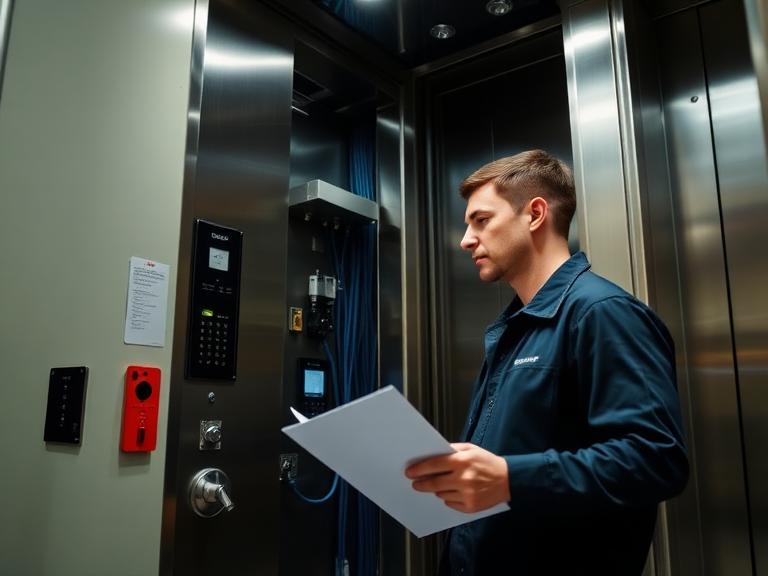
3. Dynamic Mechanical Testing Specifications
Inspectors perform controlled, high-stress stress tests to confirm the elevator’s mechanical safety systems will function properly during an actual component failure.
Standard Mechanical Verification Benchmarks
| Engineering Test Parameter | Periodic Maintenance Check | Annual Full-Load Test | 5-Year Major Safety Audit | Modernization Acceptance |
| Applied Load Weight | $0\%$ (Empty Cabin Testing) | $100\%$ of Rated Capacity | $125\%$ of Rated Capacity | $125\%$ Contract Capacity |
| Primary Testing Focus | Brake wear, door logic | Leveling, oil buffers | Dynamic safety jaws | Structural structural limits |
| Max Leveling Variance | $\pm5\text{ mm}$ limit | $\pm3\text{ mm}$ target | $\pm3\text{ mm}$ target | Less than $\pm2\text{ mm}$ (Precision) |
| Governor Trip Speed | Visual switch test | Mechanical mechanical lock | High-speed trip test | Full calibration curves |
| Buffer Compression | Visual inspection | Low-speed drift test | Full-speed impact drop | Full displacement tracking |
| Rope Diameter Wear Limit | Max $3\%$ variance | Max $6\%$ absolute wear | Max $6\%$ structural limit | Must be $0\%$ (New Ropes) |
4. Step-by-Step Execution Guide: Full-Load Drop Safety Validation
The full-load safety test evaluates the mechanical safety gears under actual emergency conditions. This test must be performed systematically by certified technicians to ensure accuracy and safety.
1.Initial Static Load Calibration:Phase 1.
Move the lift car to the top floor landing. Place certified test weights onto the cabin floor until the total load equals exactly $125\%$ of the system’s rated capacity, challenging the structural limits of the car sling and safety gear components.
2.Shaft Clearance Verification:Phase 2.
Clear all personnel from the hoistway shaft, machine room, and pit area. Set up remote diagnostic instrumentation arrays to track the car’s drop speed, deceleration rate, and stopping position without requiring a technician inside the cabin.
3.Governor Speed Override Setup:Phase 3.
Connect a variable-speed calibration motor to the overspeed governor pulley inside the machine room. This setup allows technicians to simulate an overspeed condition by driving the governor assembly past its normal trip speed while the lift motor runs at standard velocity.
4.Controlled Downward Descent and Trip:Phase 4.
Drive the heavily loaded cabin downward at full rated operational speed. Once the car passes the middle section of the shaft, accelerate the governor pulley using the calibration motor to trip the mechanical flyweights and lock the governor rope.
5.Safety Jaw Clamping Action:Phase 5.
The locked governor rope pulls the mechanical safety actuation levers beneath the moving cabin. This action forces the hardened steel safety jaws to slide up their wedges and clamp onto the solid T-rails, bringing the car to a complete stop.
6.Slide Distance and Structural Integrity Audit:Phase 6.
Lock out the main electrical panels, enter the shaft, and measure the slide marks left by the safety jaws on the guide rails. Check that the car remained level within a strict $5\text{ mm}$ limit and verify the slide distance matches the specifications in the IS 14665 code before resetting the system.
5. Modern Inspection Tools: Advanced Electronic Diagnostics
Modern inspections use highly sensitive electronic instruments to evaluate ride quality and detect hidden component wear without needing to dismantle the machinery.
- Tri-Axial Ride Quality Analyzers: Technicians place a specialized digital accelerometer on the cabin floor. As the lift travels between floors, the tool records vibrations across three axes ($X, Y,$ and $Z$). Sudden spikes in vibration can point to specific mechanical issues, such as misaligned rail joints, worn roller guide shoes, or uneven tension in the hoisting cables.
- Magnetic Flux Leakage (MFL) Wire Rope Testing: MFL testing tools use strong permanent magnets to pass a magnetic field through the steel hoisting ropes. If the field encounters internal broken wire strands, hidden corrosion pockets, or structural thinning, sensors detect the leakage fields and log the exact location of the defect. This allows building managers to replace worn cables before they pose a safety risk.
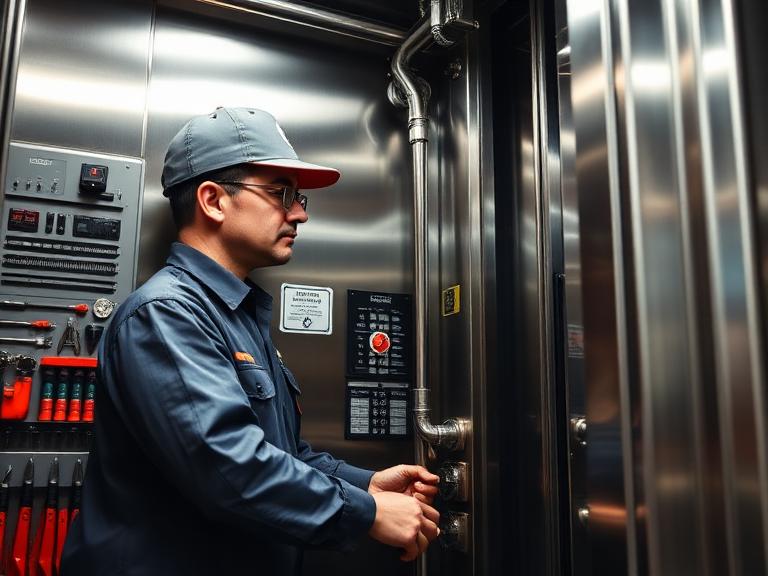
6. Comprehensive Inspection Documentation and Defect Management
At the conclusion of the inspection process, the engineering team compiles all field measurements, non-destructive testing data, and code compliance evaluations into a formal, structured safety report.
Structuring the Final Safety Report
- Executive Safety Status Summary: A direct statement confirming whether the elevator installation passed all statutory safety benchmarks or if it was issued an immediate “Stop Work” order due to critical safety violations.
- Itemized Code Violation Log: A detailed list tracking every discovered non-compliance issue. Each log entry notes the specific paragraph of the IS 14665 code that was breached, explains the safety risk, and assigns a priority level for corrective repairs.
- Comprehensive Performance Test Log: A complete record of all physical measurements taken during testing, including winding resistance values, insulation Megger readings, door closing force numbers, and full-load stopping distances. This data serves as a historical baseline for tracking component wear over time.