
Table of Contents
Enterprise Release Automation | Continuous Orchestration & Governance | Sandhata
Enterprise organizations face relentless market demand to deliver digital products, mobile banking enhancements, and omnichannel communications rapidly. However, executing software deployments at scale across complex enterprise IT ecosystems represents one of the most difficult technical challenges modern organizations encounter.
Large-scale enterprises do not operate single, isolated applications. Instead, enterprise business processes span hundreds of interconnected microservices, cloud applications, legacy databases, middleware message brokers, and core mainframe systems. Coordinating software updates across these multi-tier environments using manual release tracking, spreadsheet schedules, and manual weekend deployment windows creates severe delivery friction.
Manual release processes are inefficient, error-prone, expensive, and stressful for engineering teams. Unintended deployment mistakes frequently cause unplanned downtime, performance degradation, and compliance failures.
Enterprise Release Automation resolves these challenges. By unifying deployment pipelines, automating environment provisioning, embedding automated governance, and implementing self-healing rollout strategies, organizations can achieve high-velocity release execution alongside system stability and continuous compliance.
This guide details the technical practices, architectural blueprints, and governance controls of Sandhata Technologies’ Enterprise Release Automation consultancy, demonstrating how regulated enterprises achieve continuous release capabilities.
Section 1: The Enterprise Release Management Challenge
As enterprise software systems expand in size and complexity, manual release management approaches fail to scale. Modern technology leaders face structural release challenges that impede digital progress.
1.1 Multi-Tier System Dependencies and Release Coordination
Enterprise solutions require synchronization across multiple distinct systems. A single customer-facing application update may depend on simultaneous updates across cloud frontends, API middleware gateways, commercial platforms, and core transactional backends.
When these updates are managed manually through separate teams and disconnected release tracks, minor schedule slips in one component cascade into widespread launch delays. Coordinating these complex deployment dependencies manually requires extensive downtime windows and massive team alignment efforts.
1.2 Disconnected Automation Silos
While individual engineering teams may automate local continuous integration builds, enterprise release management requires end-to-end alignment across the entire software delivery pipeline.
When continuous integration systems, testing suites, security scanners, infrastructure scripts, and change management tools operate independently without central release orchestration, human intervention remains necessary to move software between environments. These disconnected silos create release bottlenecks, slow down deployments, and introduce human error.
1.3 Change Advisory Board Bottlenecks and Manual Compliance
In heavily regulated industries like banking, insurance, and telecommunications, software changes require strict governance, audit evidence, and segregation of duties. Traditional organizations enforce compliance by routing changes through Change Advisory Boards.
These manual board meetings rely on manual spreadsheets, tickets, and screenshots to verify release safety. Compiling this evidence requires thousands of engineering hours and delays release execution for weeks. Paradoxically, manual reviews rarely catch complex software bugs or configuration errors, leaving systems exposed to operational risks.
1.4 High Operational Costs and Unplanned Outages
Manual software releases executed during late-night or weekend deployment windows incur high operational costs and risk developer fatigue. When manual steps fail during production deployments, troubleshooting takes hours, leading to prolonged downtime, broken customer transactions, and severe reputational damage.
Section 2: Core Pillars of Sandhata’s Enterprise Release Automation Services
Sandhata Technologies provides specialized Enterprise Release Automation services designed to transform complex enterprise deployment workflows into streamlined, automated, and secure delivery pipelines.
2.1 Pillar 1: Enterprise Release Orchestration and Multi-Tier Alignment
Sandhata builds unified release orchestration frameworks that connect disparate delivery tools, cloud infrastructure providers, and internal teams into a cohesive release framework.
Rather than managing individual application deployments independently, Sandhata’s release orchestration engines manage complex, multi-system dependencies programmatically. The release engine coordinates build artifact collection, target environment verification, step-by-step service deployments, database migrations, and release health checks across cloud and on-premises environments automatically.
2.2 Pillar 2: Policy-as-Code Governance and Continuous Compliance
Sandhata replaces slow, manual change approval meetings with automated Policy-as-Code governance gates embedded directly into release pipelines.
Compliance regulations, security standards, and infrastructure policies are defined as machine-readable rules. During pipeline execution, automated governance engines check every release artifact against these rules. The system verifies that security scans have passed, code coverage metrics meet required levels, peer approvals are recorded, and open vulnerabilities are resolved.
When an artifact satisfies all policy criteria, release authorization is granted programmatically. If non-compliant configurations are detected, the pipeline automatically blocks execution and alerts development teams immediately.
2.3 Pillar 3: Zero-Downtime Deployment Strategies and Progressive Rollouts
Modern enterprise applications must remain continuously available to global users. Sandhata replaces high-risk, system-wide deployment downtime with zero-downtime deployment patterns.
Blue-Green Deployments maintain two identical production environment configurations. The active environment handles live production traffic while the passive environment receives updated application builds. Once automated health validation tests pass on the passive environment, network routing updates instantly switch live traffic to the upgraded setup, ensuring uninterrupted service.
Canary Deployments roll out software updates progressively to a small fraction of live production traffic while real-time observability tools monitor performance metrics, error rates, and system latency. As confidence builds, traffic routing automatically scales up to cover the full user base.
2.4 Pillar 4: Dynamic Rollback and Automated Self-Healing
Even extensively tested software can encounter unexpected runtime errors in production environments. Sandhata builds dynamic rollback capabilities directly into automated release pipelines.
During deployment execution, automated telemetry tools evaluate operational health indicators against baseline parameters. If error rates increase, latency spikes, or application exceptions exceed acceptable thresholds, the automated release engine halts rollout immediately and reverts network traffic to the previous stable software version. This rapid, automated self-healing capability minimizes system impact without requiring manual emergency intervention.
2.5 Pillar 5: Hybrid Cloud and Legacy Mainframe Integration
Enterprise release automation must support legacy infrastructure alongside modern cloud architectures. Sandhata specializes in coordinating deployments across hybrid IT environments.
Utilizing API adapters, pipeline runners, and Sandhata’s hyperautomation framework (ATOM2), Sandhata synchronizes deployment sequences across cloud platforms like AWS, Azure, and Google Cloud, middleware enterprise buses, and core legacy mainframes. Modern frontend microservices and legacy core backend updates execute in harmony, eliminating environment mismatches.
2.6 Pillar 6: Service Virtualization for Release Testing Decoupling
Testing enterprise releases across interconnected environments stumbles when dependent downstream interfaces are unavailable or undergo updates. Sandhata eliminates these deployment blocks using Service Virtualization.
Service Virtualization creates virtual representations of third-party payment networks, external supplier APIs, or core legacy ledgers. Release pipelines utilize these virtual services to execute dynamic end-to-end validation tests in lower environments rapidly, without waiting for physical downstream systems to become available.
Section 3: Evaluating Release Maturity with the DevOps & SRE Maturity Compass
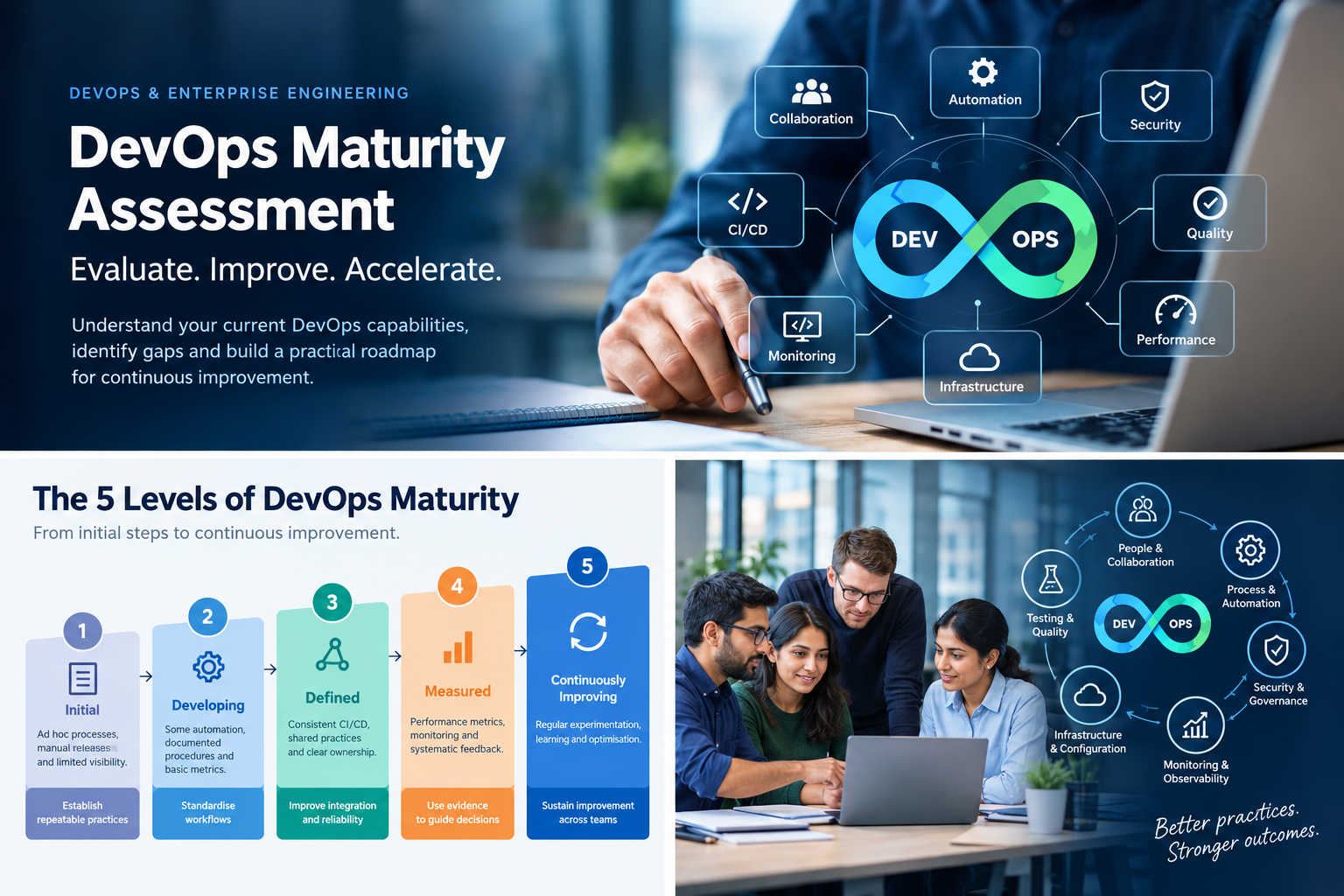
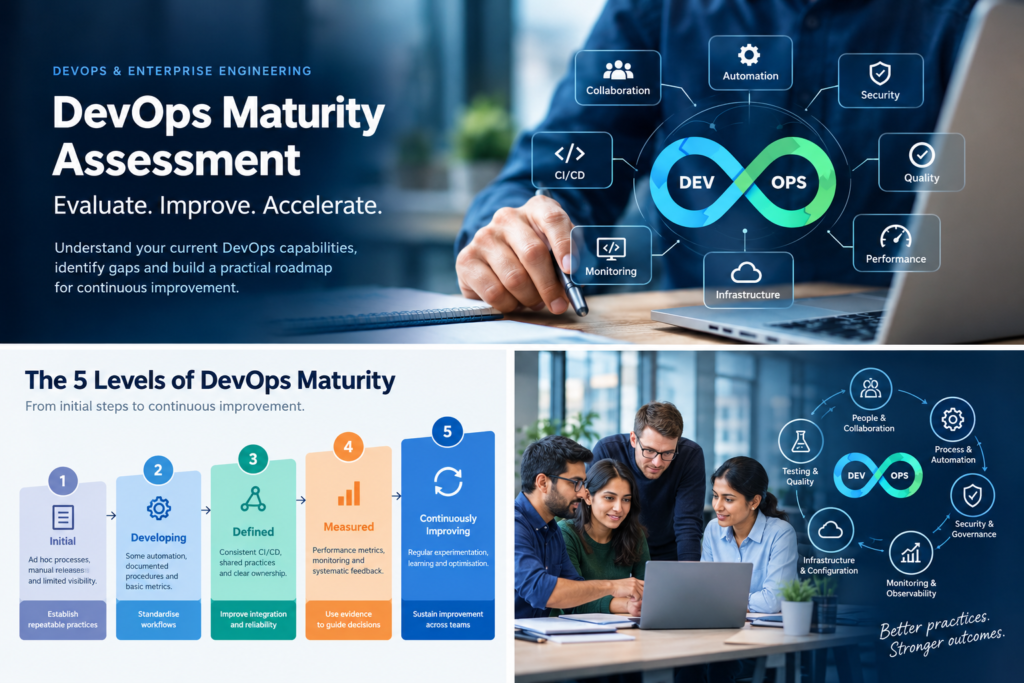
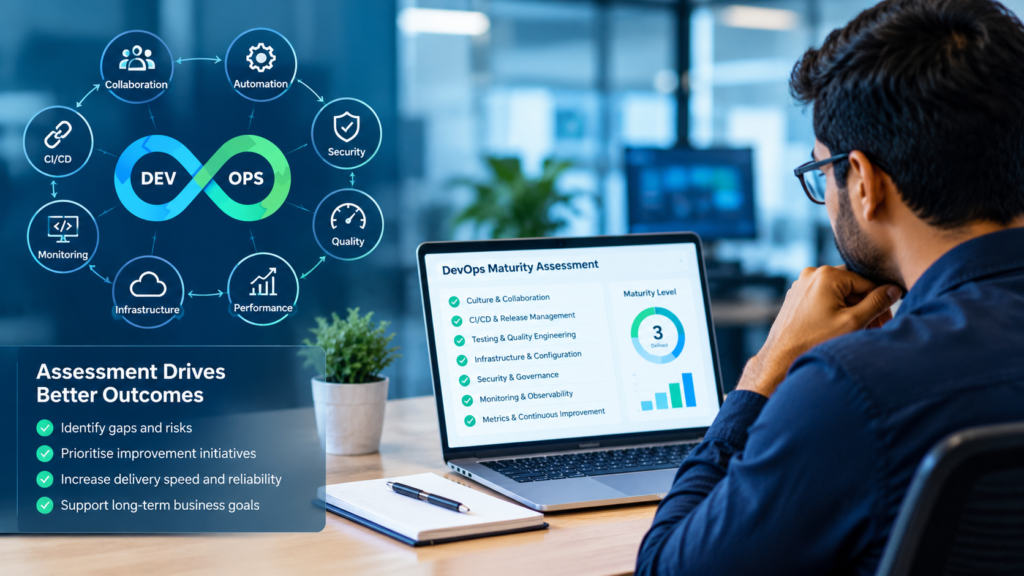
Sandhata utilizes the DevOps & SRE Maturity Compass to assist executive teams in auditing their current release management capabilities and constructing a targeted automation strategy.
Level 1: Manual Release Execution. Software releases depend on manual deployment checklists, paper approvals, spreadsheet scheduling, and weekend deployment windows. Release lead times are long, environment configuration drift is common, and change failure rates remain high.
Level 2: Siloed Pipeline Automation. Individual development teams utilize CI tools to automate code compilation and local test execution. However, release approvals, environment provisioning, multi-system coordination, and security reviews remain manual steps.
Level 3: Automated Orchestration and Gating. Centralized release orchestration coordinates multi-tier deployments. Policy-as-Code checks enforce security compliance automatically, automated test suites validate releases, and audit logs are recorded centrally.
Level 4: Continuous Release and Self-Healing Agility. Enterprise software releases run continuously using zero-downtime Blue-Green and Canary deployment strategies. Ephemeral environments validate feature branches dynamically, while automated health monitoring triggers instant rollbacks during anomalies.
The Maturity Compass offers senior leadership absolute visibility into delivery bottlenecks, compliance risks, and strategic steps to achieve automated release maturity.
Section 4: Real-World Enterprise Impact – Release Automation Case Studies
Case Study 1: Global Investment Bank Multi-System Release Orchestration
A major international investment bank managed complex trading platforms spanning cloud microservices, middleware routing systems, and core mainframe ledger systems. Manual release approvals and disconnected team deployments limited releases to quarterly cycles, causing feature backlogs and high operational costs.
Sandhata deployed a team of release automation specialists to design a central release orchestration platform. Sandhata integrated automated Policy-as-Code gates, introduced Service Virtualization for third-party trading feeds, and implemented automated Blue-Green deployment patterns.
Release lead times dropped by 84%, decreasing from 12 weeks to under 48 hours. Deployment frequency rose from quarterly releases to continuous weekly updates, while automated audit logging eliminated thousands of manual audit preparation hours.
Case Study 2: Major Telecommunications Provider Zero-Downtime Billing Modernization
A global telecommunications provider struggled with long maintenance windows when deploying updates to its online billing platform. Deployment errors frequently caused system outages during high-volume customer cycles, resulting in billing errors and increased support traffic.
Sandhata engineered an enterprise release automation solution incorporating Canary deployment strategies, automated health checks, and dynamic environment verification.
Deployment failure rates fell from 12% to below 0.5%. The provider eliminated weekend maintenance downtime completely, running seamless zero-downtime updates during regular business hours while keeping system availability at 99.999%.
Section 5: Essential Metrics for Enterprise Release Automation
Evaluating the strategic impact of Enterprise Release Automation requires measuring key performance indicators across speed, reliability, efficiency, and compliance:
Release Lead Time: The duration required for a completed code commit to move through build, test, compliance validation, and production deployment.
Deployment Frequency: How often software updates deploy into production environments successfully.
Change Failure Rate: The percentage of production deployments requiring emergency hotfixes, patches, or rollbacks. Automated policy validation maintains change failure rates under 1%.
Mean Time to Restore (MTTR): The speed at which operational services recover from unexpected runtime issues. Automated rollbacks reduce MTTR from hours to minutes or seconds.
Audit Preparation Lead Time: The total time required to gather compliance logs and change documentation for regulatory audits. Automated release pipelines reduce audit preparation time to seconds.
Section 6: Frequently Asked Questions (FAQs)
FAQ 1: What is Enterprise Release Automation?
Enterprise Release Automation is an operational methodology and technical capability that standardizes, coordinates, and automates software deployment steps across multi-tier enterprise systems, connecting code generation, testing, compliance verification, and production delivery into a unified continuous release workflow.
FAQ 2: How does Enterprise Release Automation differ from basic CI/CD pipeline automation?
While basic CI/CD automates individual application builds and deployments, Enterprise Release Automation orchestrates multi-application dependencies, environment provisioning, approval workflows, regulatory audit compliance, and system rollbacks across diverse technologies including cloud, legacy mainframes, and on-premises environments.
FAQ 3: How does release automation handle zero-downtime deployments?
Release automation enables zero-downtime deployments using deployment strategies such as Blue-Green releases and Canary deployments. These techniques route live network traffic dynamically to updated infrastructure instances only after automated validation checks confirm complete application health.
FAQ 4: Can Enterprise Release Automation integrate legacy mainframes with modern cloud environments?
Yes. Sandhata specializes in hybrid release orchestration, utilizing custom API adapters, pipeline runners, and Service Virtualization to synchronize deployment timelines across modern cloud microservices, middleware engines, and legacy mainframe systems.
FAQ 5: How does release automation support Change Advisory Board (CAB) requirements?
Enterprise Release Automation transforms manual CAB processes into continuous automated governance. The release platform automatically gathers commit metadata, automated security passes, test execution logs, and risk checks, granting programmatic release approvals when pre-set criteria are satisfied.
FAQ 6: What is Policy as Code in release governance?
Policy as Code expresses release criteria, compliance rules, and security controls in programmatic code files. Automated release gates evaluate incoming software artifacts against these policies, preventing deployment if any compliance check fails.
FAQ 7: How does Sandhata handle rollbacks in enterprise release automation?
Sandhata implements automated health verification checks during progressive deployments. If error rates increase or performance metrics degrade beyond thresholds, the release platform automatically reverts traffic to the previous stable release version without manual intervention.
FAQ 8: What role does Service Virtualization play in release automation?
Service Virtualization simulates third-party payment endpoints, external partner APIs, or core backends, allowing automated release verification testing to execute rapidly even when physical target dependencies are unavailable or undergoing maintenance.
FAQ 9: How does release automation ensure regulatory compliance for financial institutions and telecom providers?
Release automation generates immutable, cryptographically signed audit logs for every build, scan, approval, and deployment step. This provides continuous audit readiness for regulations such as DORA, PRA standards, PCI-DSS, and GDPR.
FAQ 10: What metrics are used to measure release automation efficiency?
Key metrics include Release Lead Time, Deployment Frequency, Change Failure Rate, Mean Time to Restore (MTTR), and Manual Audit Hours Saved.
FAQ 11: How does Sandhata assess an enterprise’s current release management maturity?
Sandhata applies the DevOps & SRE Maturity Compass, evaluating the enterprise across 30 to 40 structural dimensions to identify release friction points, dependency bottlenecks, and compliance risks before designing a customized automation strategy.
FAQ 12: What are progressive deployments in release orchestration?
Progressive deployment is a strategy where software updates are rolled out to a small percentage of users first while monitoring performance metrics. As confidence increases, the system automatically expands the deployment to remaining user segments.
FAQ 13: How does Enterprise Release Automation manage environment configuration drift?
By incorporating Infrastructure as Code and immutable configuration templates within the release pipeline, every target environment is automatically constructed or validated against exact code definitions, eliminating configuration drift across development, staging, and production.
FAQ 14: How does Sandhata’s ATOM2 platform support hyperautomation in releases?
Sandhata’s ATOM2 platform delivers low-code and no-code hyperautomation capabilities that simplify release coordination, automate multi-tool approvals, and connect disparate delivery utilities into unified release flows.
FAQ 15: How long does it take to implement Enterprise Release Automation with Sandhata?
Initial discovery and maturity assessment take 2 to 4 weeks. Standardized release pipelines, automated compliance gates, and pilot application migrations deliver operational results within 8 to 12 weeks.
Strategic Recommendation and Next Steps
Relying on manual release management processes, spreadsheet tracking, and weekend downtime windows introduces severe operational risk, increases delivery costs, and limits business growth. To remain competitive in digital-first markets, enterprise organizations must transition to automated, continuous, and orchestrated software delivery.
Enterprise Release Automation offers a clear strategy for modernizing software delivery. By automating multi-system dependencies, embedding Policy-as-Code governance, implementing zero-downtime deployment patterns, and integrating hybrid cloud-mainframe systems, enterprises can accelerate release cadences while ensuring operational stability and continuous regulatory compliance.
Sandhata Technologies brings over two decades of engineering excellence in release orchestration across heavily regulated industries.
Contact Sandhata’s Enterprise Release Engineering Specialists today to schedule your DevOps & SRE Maturity Compass Assessment and modernize your release delivery capabilities.



Leave a Comment