
Table of Contents
SRE Services for Enterprises: Enterprise Site Reliability Engineering | Sandhata
As enterprise IT architectures transition to hybrid clouds, microservices, and distributed systems, operational complexity increases exponentially. Outages in banking, telecommunications, or healthcare lead to severe financial loss, regulatory fines, and brand damage.
Traditional IT operations—reliant on manual incident triage, siloed monitoring, and reactive ticket management—cannot maintain high availability in these complex environments.
Site Reliability Engineering (SRE) offers a modern alternative. By applying software engineering practices directly to operational challenges, SRE bridges the gap between fast software delivery and overall system stability.
Comprehensive SRE Services for Enterprises provide the framework, engineering skills, and operational tools required to transform fragile systems into self-healing, highly available enterprise engines.
This guide explores the strategic importance of enterprise SRE services, details Sandhata Technologies’ approach to reliability engineering, outlines key operational pillars, and provides answers to critical SRE questions.
Section 1: The Reliability Crisis in Modern Enterprises
In large-scale enterprise environments, system outages are rarely caused by a single isolated failure. Instead, they result from systemic complexity, hidden dependencies, and manual operational workflows.
1.1 The High Cost of Unplanned Downtime
For tier-one banks and global telecommunications providers, system downtime costs millions per hour. Beyond direct financial loss, outages breach regulatory mandates like the Digital Operational Resilience Act (DORA) and Prudential Regulation Authority guidelines, leading to severe regulatory penalties.
1.2 Operational Toil and Engineer Burnout
Enterprise operations teams spend up to 70% of their time on manual, repetitive operational toil—such as manual server restarts, routine log clearing, password rotations, and manual incident logging. This repetitive workload leaves minimal time for strategic infrastructure improvements and causes engineer burnout.
1.3 Siloed Monitoring and Alarm Fatigue
Enterprises frequently maintain dozens of disconnected monitoring tools across cloud environments, legacy mainframes, and third-party APIs. This creates fragmented visibility and alarm fatigue. When incident storms occur, operational teams waste hours identifying the true root cause among thousands of redundant alerts.
1.4 Friction Between Feature Velocity and Operational Stability
Development teams are incentivized to release new features quickly, while traditional operations teams are incentivized to maintain system stability by restricting changes. This misalignment creates organizational friction, delayed releases, and risky, large-scale software deployments.
Section 2: Core Engineering Pillars of Sandhata’s Enterprise SRE Services
Sandhata Technologies delivers specialized SRE Services for Enterprises that resolve operational friction. Sandhata combines deep technical execution with specialized advisory frameworks to transform enterprise IT operations.
2.1 Pillar 1: Service Level Management and Error Budget Governance
Sandhata establishes clear reliability metrics by defining Service Level Indicators (SLIs) and Service Level Objectives (SLOs). SLIs track quantitative performance metrics—such as latency, throughput, and availability—while SLOs establish clear reliability targets aligned with business needs.
Sandhata introduces Error Budget governance to balance development velocity with operational stability. An error budget represents the acceptable margin of system degradation (for example, a 99.9% uptime target allows a 0.1% error budget). If a system operates within its error budget, software teams can deploy features freely. If the error budget is exhausted, deployments pause to focus on stability and performance engineering.
2.2 Pillar 2: Toil Reduction through Hyperautomation
Sandhata helps enterprises eliminate manual operational tasks by applying automated workflows across the operational lifecycle. Utilizing advanced automation scripts and proprietary solutions like the ATOM2 hyperautomation platform, Sandhata automates routine system maintenance, capacity scaling, patch management, and health checks.
Reducing manual toil below 30% of operational effort frees engineering teams to focus on proactive reliability projects, system architecture refinements, and continuous performance optimization.
2.3 Pillar 3: Enterprise Observability Engineering
Modern distributed architectures require deep visibility into application states. Sandhata replaces basic monitoring with complete Observability Engineering, implementing unified telemetry stacks across metrics, logs, and distributed traces.
By correlating telemetry across multi-cloud environments, modern microservices, and legacy backend mainframes, Sandhata provides real-time visibility through single-pane-of-glass dashboards. Intelligent alerting algorithms group related anomalies, eliminating alarm noise and enabling teams to identify root causes rapidly.
2.4 Pillar 4: Automated Incident Response and Self-Healing Systems
Minimizing Mean Time to Restore (MTTR) requires automated incident response routines. Sandhata designs self-healing architectures that detect and mitigate operational issues automatically.
When abnormal system metrics are detected, automated remediation routines trigger immediately—restarting unhealthy container pods, rebalancing server workloads, flushing saturated caches, or executing failover protocols. For complex incidents, automated paging systems route contextual incident reports directly to on-call engineers, accelerating remediation.
2.5 Pillar 5: Chaos Engineering and Proactive Resilience Testing
Waiting for production outages to discover system vulnerabilities introduces unnecessary operational risk. Sandhata embeds Chaos Engineering practices into enterprise staging and production environments to test resilience proactively.
By introducing controlled failure scenarios—such as network latency spikes, database disconnects, or node outages—Sandhata verifies that automated failover mechanisms, circuit breakers, and self-healing routines execute correctly. This proactive approach uncovers hidden bugs before they impact end users.
2.6 Pillar 6: Unified Mainframe and Hybrid Reliability Integration
Enterprise platforms frequently combine cloud-native frontend architectures with core mainframe backends. Sandhata integrates legacy mainframes into modern SRE frameworks.
By establishing telemetry pipelines for mainframe operating environments, Sandhata ensures that COBOL workloads, dataset processing, and transaction queues are monitored alongside cloud microservices. This provides holistic operational governance across the entire enterprise stack.
Section 3: The Sandhata DevOps & SRE Maturity Compass
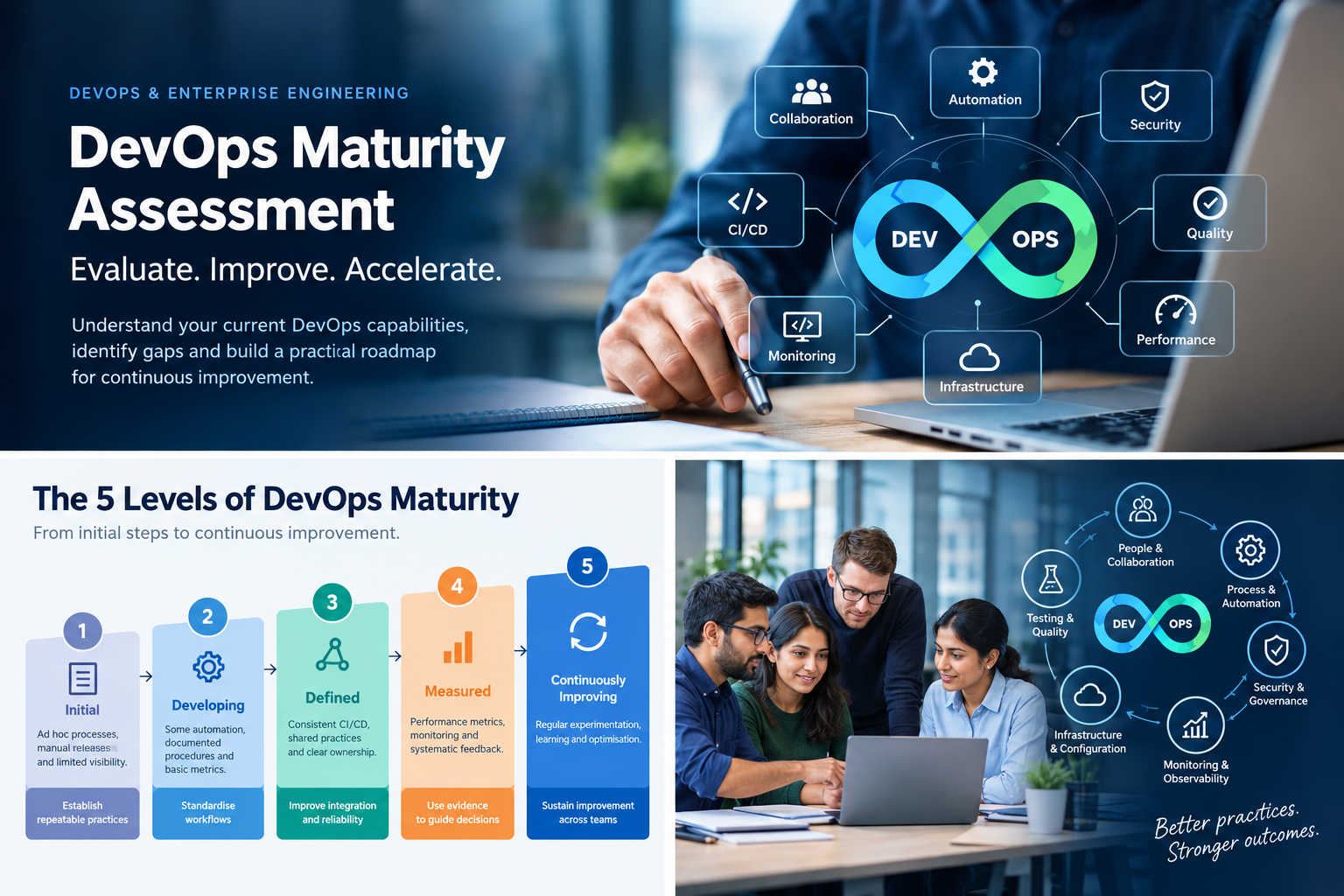
To guide SRE transformations, Sandhata utilizes the DevOps & SRE Maturity Compass—a practical evaluation framework that assesses enterprise operational maturity across 30 to 40 dimensions.
Level 1: Reactive Operations. Incident response is completely manual, monitoring is fragmented, and no formal SLOs exist. Outages cause long recovery times and significant business disruption.
Level 2: Basic Automation. Basic monitoring tools are deployed and automated scripts handle minor tasks. However, operational toil remains high, and error budgets are not tracked or enforced.
Level 3: Telemetry-Driven SRE. SLI and SLO metrics are actively measured across business services. Centralized observability platforms reduce Mean Time to Restore, and automated remediation handles common failure scenarios.
Level 4: Advanced Reliability. Error budgets govern release velocity automatically. Hyperautomation handles routine maintenance, chaos engineering validates resilience continuously, and unified telemetry spans all legacy and cloud architectures.
The Maturity Compass provides enterprise leaders with a clear baseline, identifies operational risks, and delivers a step-by-step roadmap for implementing enterprise-grade SRE.
Section 4: Enterprise Impact – Real-World SRE Case Studies
Case Study 1: Global Retail Bank Core System Reliability
A leading retail bank experienced frequent micro-outages during peak trading hours due to high transaction volumes across core banking APIs and mainframe backends. Uncoordinated alert storms resulted in long resolution times averaging over 4 hours per incident.
Sandhata deployed a dedicated team of SRE specialists to implement enterprise observability, establish clear SLOs for critical customer journeys, and build automated incident response workflows.
The team deployed correlated telemetry pipelines, created automated incident triage routines, and built self-healing circuit breakers for high-traffic APIs.
The results were immediate: Mean Time to Restore (MTTR) dropped by 75%, falling from 4 hours to under 25 minutes. Critical customer-facing service availability increased to 99.99%, saving millions in potential outage costs and ensuring compliance with banking regulatory standards.
Case Study 2: Tier-1 Telecommunications Platform Transformation
A major telecommunications provider faced high operational toil managing hybrid multi-cloud infrastructure supporting millions of mobile subscribers. Operational teams spent most of their working hours manually triaging alerts and performing routine system maintenance.
Sandhata implemented an SRE transformation program centered around toil reduction and automated infrastructure lifecycle management. Utilizing Sandhata’s hyperautomation capabilities, the team automated system health checks, database maintenance routines, and capacity scaling triggers.
Operational toil was reduced by 60%, allowing engineering teams to shift their focus to proactive reliability engineering. Change failure rates dropped to under 1.5%, and automated incident response lowered overall operational expenses by 35%.
Section 5: Key Metrics for Measuring Enterprise SRE Success
Evaluating an SRE transformation requires tracking clear performance and business metrics. Sandhata focuses on delivering measurable improvements across key operational indicators:
Mean Time to Restore (MTTR): The average time required to recover from a system failure. SRE automation typically reduces MTTR from hours to minutes.
Mean Time Between Failures (MTBF): The average operational time between unexpected system outages. Proactive resilience engineering increases MTBF significantly over time.
Toil Reduction Ratio: The percentage of operational effort spent on repetitive, manual tasks versus high-value engineering work. Effective SRE implementations reduce toil below 30%.
SLO Achievement Rate: The percentage of operational time systems meet or exceed agreed Service Level Objectives.
Error Budget Burn Rate: Real-time tracking of how quickly system failures consume allowable reliability margins, providing early warnings before outages breach SLAs.
Change Failure Rate: The percentage of software updates or infrastructure changes that cause production degradation. Automated reliability checks lower this metric under 2%.
Section 6: Frequently Asked Questions (FAQs)
FAQ 1: What are SRE Services for Enterprises?
SRE Services for Enterprises apply software engineering practices to infrastructure and IT operations. These services focus on constructing scalable, self-healing systems, establishing quantitative reliability targets (SLOs), eliminating operational toil, and maintaining high availability across complex enterprise architectures.
FAQ 2: How does Site Reliability Engineering differ from traditional IT operations?
Traditional IT operations rely on manual system monitoring, reactive ticket handling, and siloed maintenance. SRE treats operations as a software engineering problem, utilizing automation, error budget governance, telemetry-driven observability, and proactive reliability engineering to prevent downtime.
FAQ 3: What is an Error Budget and how does it balance innovation with stability?
An Error Budget represents the acceptable amount of system downtime or performance degradation calculated from a Service Level Objective (SLO). If a system operates within its error budget, product teams can ship new features rapidly. If the error budget is exhausted, releases pause until system stability is restored.
FAQ 4: How does Sandhata reduce operational toil for enterprise IT teams?
Sandhata reduces operational toil by automating repetitive manual tasks such as server patching, database maintenance, health checks, and alert verification using automated scripts, self-healing platforms, and hyperautomation solutions like ATOM2.
FAQ 5: What are SLIs, SLOs, and SLAs in Enterprise SRE?
Service Level Indicators (SLIs) are specific quantitative measures of system performance, such as request latency or error rate. Service Level Objectives (SLOs) are target goals for those metrics agreed upon by business and technical teams. Service Level Agreements (SLAs) are formal contracts defining commercial consequences if SLOs are missed.
FAQ 6: How does Sandhata integrate SRE across legacy mainframes and modern cloud environments?
Sandhata designs unified telemetry pipelines that connect legacy mainframe operational metrics with modern cloud observability platforms. This provides single-pane-of-glass visibility and unified incident management across both cloud-native applications and legacy backends.
FAQ 7: What role does Observability play in enterprise SRE services?
Observability goes beyond simple monitoring by collecting structured logs, distributed tracing, and real-time metrics. This enables engineering teams to understand the internal state of complex systems, diagnose root causes instantly, and predict system failures before outages occur.
FAQ 8: How does Chaos Engineering fit into enterprise SRE transformation?
Chaos Engineering injects controlled, artificial failures into staging or production systems to uncover hidden weaknesses, validate automated failovers, and ensure self-healing routines execute correctly under unexpected operational stress.
FAQ 9: How do enterprise SRE services support regulatory compliance in banking and telecommunications?
SRE services establish deterministic recovery protocols, automated audit logging, continuous compliance monitoring, and strict uptime governance that satisfy regulatory standards like DORA, PRA regulations, and PCI-DSS compliance.
FAQ 10: What is the role of automated incident management in SRE?
Automated incident management replaces manual triage with automated alert correlation, intelligent escalation routing, self-healing remediation routines, and automated post-incident review data collection to minimize Mean Time to Restore (MTTR).
FAQ 11: How does Sandhata help organizations transition from DevOps to SRE?
Sandhata assesses current operational maturity using the DevOps & SRE Maturity Compass, establishes SLO governance models, embeds reliability practices into delivery pipelines, and trains internal teams to manage systems as reliability engineers.
FAQ 12: What metrics are used to measure the success of an enterprise SRE engagement?
Key success metrics include Mean Time to Restore (MTTR), Mean Time Between Failures (MTBF), percentage of toil reduction, error budget burn rates, Service Level Objective achievement percentages, and change failure rates.
FAQ 13: Can SRE services help lower cloud compute and infrastructure costs?
Yes. SRE services optimize resource allocation by removing unnecessary compute capacity, automating autoscaling policies, identifying redundant monitoring tools, and eliminating underutilized infrastructure.
FAQ 14: How does Sandhata implement self-healing infrastructure?
Sandhata configures automated remediation scripts and container orchestration rules that trigger automatically when anomalies are detected, restarting degraded pods, clearing memory leaks, or rerouting traffic without human intervention.
FAQ 15: How long does an enterprise SRE transformation engagement take with Sandhata?
Initial maturity assessments and baseline SLO creation typically take 2 to 4 weeks, while full enterprise observability implementation, toil reduction programs, and SRE culture adoption yield high-impact results within 3 to 6 months.
Strategic Recommendation and Next Steps
In an increasingly digital global economy, system reliability directly impacts business revenues and customer trust. Continuing to manage complex enterprise infrastructure with legacy operational models introduces unacceptable risks of downtime, regulatory penalties, and lost market share.
Sandhata Technologies provides the specialized engineering experience required to build resilient, high-availability IT platforms. With over 20 years of expertise across regulated sectors, Sandhata helps enterprises transform fragile operational workflows into high-performing, self-healing systems.
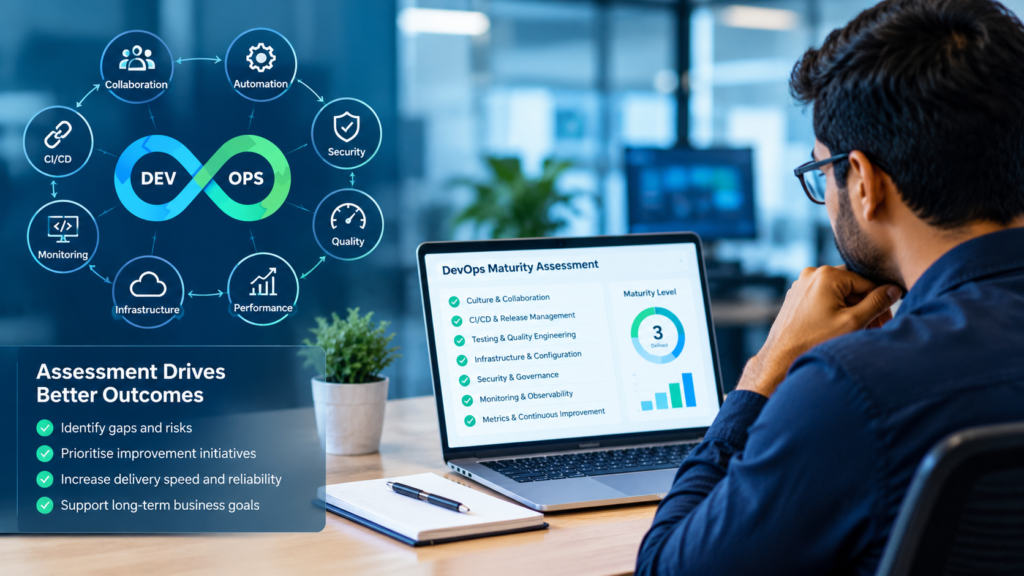
Contact Sandhata’s Site Reliability Engineering Specialists today to schedule your DevOps & SRE Maturity Compass Assessment and start building a modern, reliable enterprise infrastructure.



Leave a Comment