
Table of Contents
Top EV Charger Installation Company in Hyderabad (2026): TGSPDCL & TGREDCO Guide
The transformation of Hyderabad into a zero-emission technology and commercial hub has created unprecedented demand for reliable, high-power electric vehicle supply equipment (EVSE). Across major commercial corridors like HITEC City, Gachibowli, Nanakramguda, and Madhapur, as well as high-density residential developments in Kondapur, Tellapur, Miyapur, and Kompally, selecting an experienced EV charger installation company in Hyderabad is a strategic priority for property developers, facility managers, and fleet operators.
Deploying commercial or residential EV charging infrastructure involves navigating a complex web of technical, electrical, and regulatory requirements. Site hosts must balance grid load approvals from TGSPDCL (Telangana State Southern Power Distribution Company Limited), state nodal clearances from TGREDCO (Telangana State Renewable Energy Development Corporation), statutory safety inspections from the CEIG (Chief Electrical Inspectorate to Government), and site-level dynamic energy management.
This comprehensive technical guide outlines the full scope of work, engineering standards, regulatory frameworks, financial models, and statutory compliance required when partnering with a professional turnkey EV charger installation company in Hyderabad.
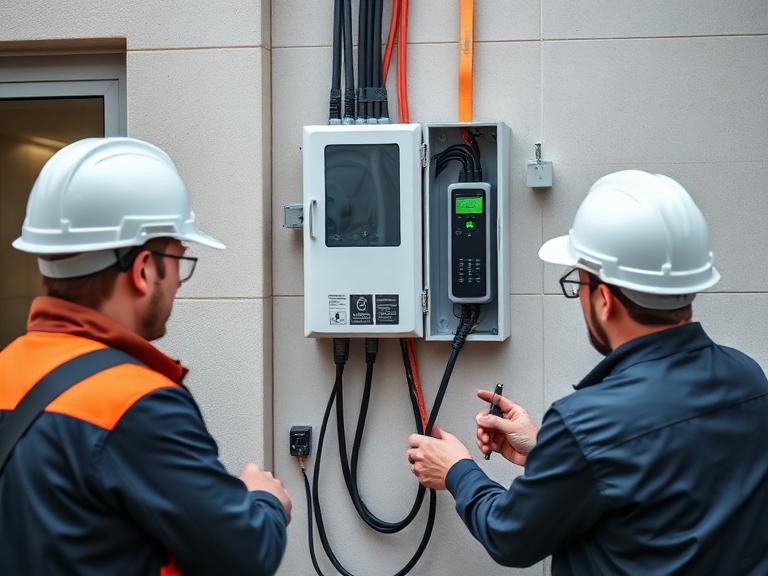
1. Scope of Work Delivered by a Turnkey EV Charger Installer
A specialized EV charger installation company in Hyderabad delivers end-to-end electrical, civil, regulatory, and software orchestration to transform raw physical space into a grid-compliant, operational charging asset.
Rather than acting merely as hardware distributors or general electrical contractors, enterprise EV infrastructure installers manage the entire deployment lifecycle:
Phase 1: Site Feasibility & Spatial Engineering
- Load Margin Audits: Measuring local distribution transformer capacity, main breaker panel headroom, and short-circuit withstand levels.
- Cable Routing & Civil Mapping: Mapping optimal conduit pathways through basement cable trays or outdoor trenches to minimize voltage drop across extended copper runs.
- Fire Safety & Environmental Audits: Inspecting basement ventilation systems, fire suppression coverage, and drainage pathways to ensure compliance with local municipal codes.
Phase 2: Statutory Approvals & Grid Permitting
- TGREDCO Single-Window Filings: Submitting site plans and electrical single-line diagrams (SLDs) on the TGREDCO portal to secure state nodal No Objection Certificates (NOCs).
- TGSPDCL Tariff Approvals: Applying for dedicated meter connections under concessional EV tariff categories (LT-IX or HT-EV) to secure low operating energy costs.
- CEIG Safety Inspections: Coordination with the Chief Electrical Inspectorate to Government (CEIG), Telangana, for mandatory physical safety audits on three-phase and high-voltage DC equipment.
Phase 3: Civil Works & Heavy Electrical Execution
- Sub-Panel & Transformer Deployment: Installing dedicated step-down transformers, K-factor harmonic isolation units, and main distribution panels.
- Protective Civil Construction: Pouring elevated concrete pads, installing steel bollards (IK10 impact rated), and executing directional boring for underground armored feeder cables.
- Dedicated Earthing Isolation: Sinking dual chemical earthing pits using copper-bonded steel electrodes to achieve electrical resistance consistently under 1 Ohm.
Phase 4: Software Integration & Operations
- Cloud CPMS Provisioning: Connecting physical chargers to a Charge Point Management System (CPMS) using OCPP 2.0.1 over secure WebSockets.
- Monetization & Energy Control: Integrating UPI QR code payment gateways, configuring dynamic Time-of-Use (ToU) tariffs, and enabling Dynamic Load Management (DLM) to prevent grid overloads.
2. Navigating Hyderabad’s Regulatory Framework: TGSPDCL, TGREDCO & CEIG
Successfully deploying commercial or multi-family EV chargers in Hyderabad requires strict compliance with Telangana’s statutory regulatory bodies:
TGSPDCL (Telangana State Southern Power Distribution Company Limited)
TGSPDCL governs grid interconnection, distribution transformers, service drops, and billing meters across Hyderabad.
- LT-IX EV Tariff (Low Tension – Below 56 kW / 75 HP): Designed for smaller commercial setups and multi-family residential clusters. TGSPDCL provides a concessional single-part energy charge fixed at ₹6.00 per unit/kWh with ₹0 fixed monthly demand charges, making it significantly more economical than standard LT-II commercial tariffs (which range from ₹8.50 to ₹11.00 per unit).
- HT-EV Tariff (High Tension – 11kV/33kV Connection): Mandatory for high-power DC fast-charging plazas, logistics fleet hubs, and major IT park deployments drawing over 56 kW. Energy charges sit at a concessional baseline of ₹6.00 per kWh alongside a nominal demand fee of ₹100 per kVA per month.
TGREDCO (Telangana State Renewable Energy Development Corporation)
TGREDCO acts as the State Nodal Agency (SNA) for EV charging infrastructure under the Telangana Clean and Green Policy. A professional installation company files site details on TGREDCO’s single-window portal to secure the required NOC, register the station for state capital subsidies (where applicable under scheme rules), and list the station on official public navigation maps.
CEIG (Chief Electrical Inspectorate to Government, Telangana)
Under the Central Electricity Authority (CEA) Safety Regulations and Indian Electricity Rules, any commercial EV charging installation operating above 250V (which includes all three-phase AC wallboxes and high-voltage DC fast chargers) or drawing high power must pass a physical safety inspection by the CEIG Telangana prior to grid energization.
3. Hardware Specifications Across Primary Hyderabad Deployment Scenarios
Selecting the appropriate hardware configuration prevents over-investing in transformer capacity while meeting driver dwell expectations:
Scenario 1: Multi-Family Residential Gated Communities
- Locations: Kondapur, Tellapur, Miyapur, Kompally, Nallagandla.
- Hardware Topology: Smart AC Level 2 Wallboxes ($7.4\text{ kW} – 11\text{ kW}$ single-phase / three-phase).
- Electrical Parameters: 230V/415V, 32A per port, 8 AWG armored copper cable, 40A MCB, Type-B RCD leakage protection.
- Dwell Time & Application: Overnight resident charging (6 to 10 hours dwell time) with individual RFID card activation.
Scenario 2: IT Parks & Corporate Office Garages
- Locations: HITEC City, Gachibowli, Nanakramguda, Madhapur.
- Hardware Topology: Commercial Dual-Gun AC Level 2 Wallboxes ($11\text{ kW} – 22\text{ kW}$ three-phase).
- Electrical Parameters: 415V, 32A per gun, 4 AWG copper cabling, dedicated LT sub-panel, Dynamic Load Management (DLM) integration.
- Dwell Time & Application: Employee commuter charging during working hours (4 to 8 hours dwell time) integrated with corporate employee access badges.
Scenario 3: Commercial Malls, Retail Plazas & Hotels
- Locations: Banjara Hills, Jubilee Hills, Begumpet, Somajiguda.
- Hardware Topology: Compact Dual-Gun CCS2 DC Fast Chargers ($30\text{ kW} – 60\text{ kW}$).
- Electrical Parameters: 415V 3-phase input, 80A-150A continuous current draw, internal SiC power modules, dedicated K-factor isolation transformer.
- Dwell Time & Application: Quick-turn visitor charging (30 to 90 minutes dwell time) with automated UPI QR code payment clearing.
Scenario 4: Highway Travel Corridors & Logistics Fleet Depots
- Locations: Outer Ring Road (ORR) exits, Shamshabad Airport corridor, Patancheru logistics parks.
- Hardware Topology: High-Power Ultra-Fast HPC DC Cabinets ($120\text{ kW} – 240\text{ kW+}$).
- Electrical Parameters: High Tension (11kV/33kV) direct grid feed, dedicated 250+ kVA step-down transformer, active liquid-cooled cable dispensers.
- Dwell Time & Application: Ultra-fast express charging (15 to 30 minutes dwell time) for passenger EVs and commercial delivery fleets.
4. Engineering Standards & Safety Protection Systems
Enterprise installation companies adhere to strict electrical safety standards to protect human life, property, and high-voltage vehicle battery packs:
- Dual Chemical Earthing Pits: Installer crews sink two independent chemical earthing pits using copper-bonded steel electrodes embedded in conductive bentonite compound to guarantee earth resistance measures consistently under 1 Ohm.
- Type-B Residual Current Devices (RCD): Standard AC circuit breakers fail to detect smooth DC leakage currents. Turnkey installers integrate Type-B RCDs (or built-in 6mA DC leakage protection sensors) to isolate fault conditions instantly.
- Surge Protection Devices (SPD): Installing Type-2 SPDs inside main distribution panels shields delicate charger microcontrollers and power conversion modules from grid voltage spikes during monsoon lightning storms.
- Monsoon & Thermal Enclosure Weatherproofing: Due to summer ambient temperature spikes (exceeding 42°C) and heavy monsoon downpours in Telangana, outdoor DC chargers require IP65 or IP55 weatherproof enclosures, IK10 impact-resistant steel bollards, elevated concrete mounting pads, and protective shaded canopies.
5. Cost Analysis & Turnkey Investment Breakdown in Hyderabad
The total turnkey cost to install EV charging infrastructure in Hyderabad depends on cable run lengths, civil trenching needs, charger capacity, and TGSPDCL grid drop fees:
6. Step-by-Step Installation Execution Sequence
Partnering with a professional installation company follows a structured 5-step operational process:
- Step 1: On-Site Engineering Audit & Load Feasibility Engineers measure main panel margin, calculate cable voltage drop over distance, inspect basement fire suppression systems, and draft electrical single-line diagrams (SLDs).
- Step 2: Statutory Approvals & Load Sanctioning The installation team files for a TGREDCO single-window NOC and submits documentation to TGSPDCL for dedicated LT-IX or HT-EV tariff meter drops.
- Step 3: Civil Construction & Cable Pulling Crews perform trenching or directional boring, pour elevated concrete mounting pads, install protective steel bollards, and lay heavy-gauge armored copper feeder cables.
- Step 4: Interconnect, Earthing & CEIG Safety Audit Engineers terminate power lines inside switchgear, sink chemical earthing pits ($<1\Omega$), install Type-B RCD protection, and pass CEIG physical safety inspections.
- Step 5: Cloud CPMS Provisioning & Go-Live The charger connects via OCPP 2.0.1 WebSockets to a cloud backend, enabling automated UPI QR code payments, Dynamic Load Management (DLM), and live mapping on navigation apps.
Frequently Asked Questions (15 Detailed FAQs)
Q1: Why should I hire a professional EV charger installation company in Hyderabad?
Hiring a specialized installation company ensures your project complies with TGSPDCL electricity tariffs, secures TGREDCO NOC approvals, meets CEIG electrical safety regulations, implements proper chemical earthing ($<1\Omega$), and prevents building panel overloads.
Q2: What is the TGSPDCL power tariff for EV charging stations in Hyderabad?
TGSPDCL offers a dedicated concessional tariff category (LT-IX / HT-EV) for electric vehicle charging across Hyderabad. Billed at a single-part energy charge of ₹6.00 per unit/kWh with ₹0 fixed monthly demand charges for LT connections, it is significantly lower than standard commercial electricity rates (₹8.50–₹11.00/unit).
Q3: How long does a turnkey commercial EV charger installation take in Hyderabad?
Commercial DC fast-charging projects typically take 3 to 6 weeks from initial site audit to go-live activation. This covers TGREDCO single-window registration, TGSPDCL load sanctioning, civil concrete works, cabling, and CEIG safety inspection sign-off.
Q4: Do installation companies help with RWA NOC approvals for multi-family apartments?
Yes. Professional installation companies assist apartment residents and Resident Welfare Associations (RWAs) by providing single-line diagrams, load balancing designs, and safety documentation needed to obtain formal board approval.
Q5: Is CEIG safety inspection mandatory for EV charger installation in Telangana?
Yes. Any commercial EV charging installation operating above 250V (which includes three-phase 22 kW AC wallboxes and all DC fast chargers) must pass a physical safety inspection by the Chief Electrical Inspectorate to Government (CEIG) before grid energization.
Q6: What electrical protection hardware is required for commercial EV chargers?
Mandatory safety hardware includes Type-B RCDs (or 6mA DC leakage protection), Miniature Circuit Breakers (MCB), Surge Protection Devices (SPD Type 2), emergency stop switches, and two chemical earthing pits with resistance under 1 Ohm.
Q7: How much does it cost to install a commercial DC fast charger in Hyderabad?
Turnkey installation for a 30 kW DC fast charger costs between ₹5.20 Lakhs and ₹8.60 Lakhs, while a dual-gun 60 kW DC fast charger ranges from ₹9.70 Lakhs to ₹15.00 Lakhs, covering hardware, cabling, civil works, and utility drop fees.
Q8: What is TGREDCO’s role in approving EV charging stations in Hyderabad?
TGREDCO acts as the State Nodal Agency (SNA). An installation company registers the site on TGREDCO’s single-window portal to secure a necessary NOC, qualify for state capital subsidies where applicable, and feature the station on official public navigation apps.
Q9: Can an installation company set up automated UPI payments for commercial chargers?
Yes. Turnkey installers connect OCPP-compliant chargers to cloud Charge Point Management Systems (CPMS) that support automated UPI QR code payments, session tracking, and dynamic pricing.
Q10: What is Dynamic Load Management (DLM) and why is it important for Hyderabad buildings?
Dynamic Load Management is a software feature that monitors real-time building electrical draw using smart meters. It automatically throttles power allocated to connected EV chargers during peak HVAC hours, preventing main panel overloads and avoiding expensive transformer upgrade fees.
Q11: What weatherproofing standards are required for outdoor chargers in Hyderabad?
Outdoor chargers require IP65 or IP55 weatherproof enclosures, IK10 impact protection, elevated concrete pads, and protective canopies to withstand summer heat spikes (exceeding 42°C) and heavy monsoon downpours.
Q12: What is the difference between LT-IX and HT-EV grid connections in Hyderabad?
LT-IX (Low Tension) connections apply to smaller commercial setups drawing under 56 kW. HT-EV (High Tension 11kV/33kV) connections are required for high-power DC fast-charging plazas drawing over 56 kW.
Q13: Do turnkey installers provide ongoing maintenance support?
Yes. Reputable EV charger installation companies offer maintenance Service Level Agreements (SLAs) covering routine physical checks, earthing continuity audits, software updates, and emergency repair dispatch.
Q14: How does an installation company perform chemical earthing for EV chargers?
Installers sink two copper-bonded steel electrodes into deep boreholes filled with conductive bentonite chemical compound, ensuring earth pit resistance stays strictly below 1 Ohm.
Q15: What is the recommended charger mix for an office building in HITEC City?
A recommended corporate setup combines dual-gun 11 kW to 22 kW AC Level 2 wallboxes for employee vehicles parked for 4 to 8 hours, alongside one or two 30 kW to 60 kW CCS2 DC fast chargers for executive vehicles and quick visitor top-ups.
Turnkey Partner Selection Checklist for Hyderabad
Partnering with an experienced EV charger installation company in Hyderabad bridges physical electrical engineering with cloud software orchestration. By securing TGSPDCL concessional tariffs, obtaining TGREDCO single-window approvals, adhering to CEIG safety standards, and deploying robust OCPP-compliant hardware, property managers and Charge Point Operators can build future-proof, high-yield charging assets across Telangana’s capital.